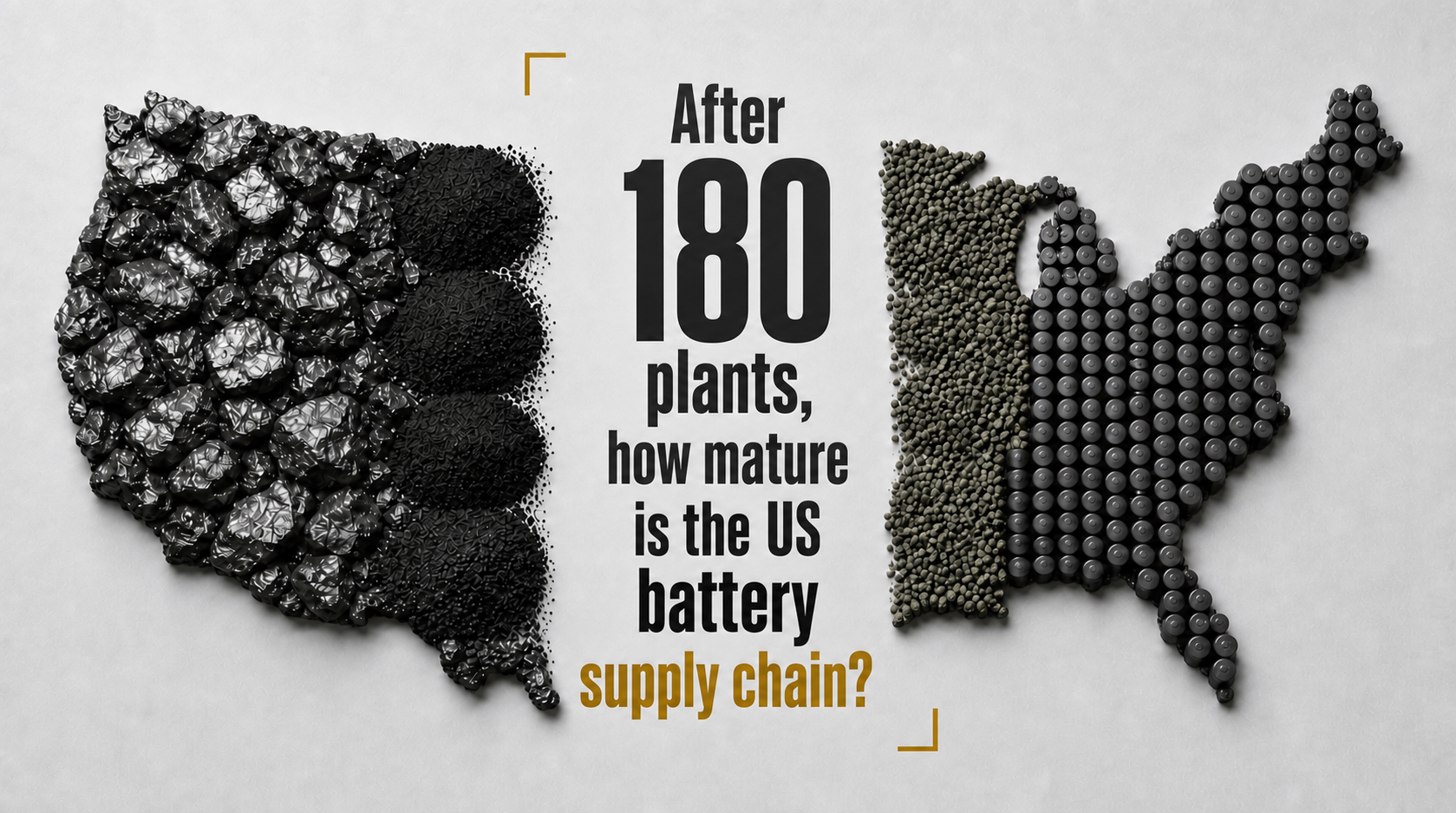
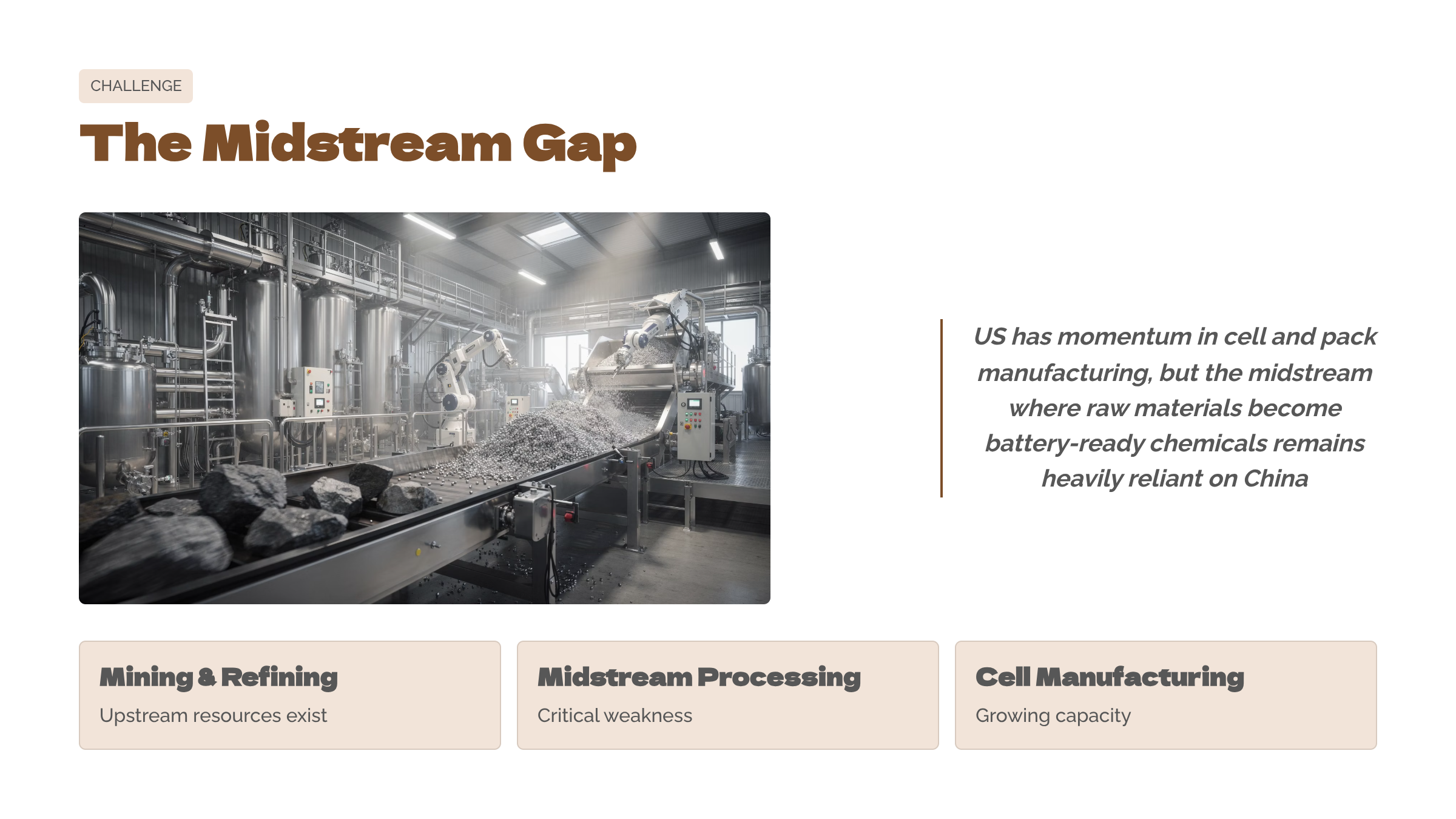
A simple way to visualize this challenge is to look at the battery value chain,from mining and refining to cathode and anode active materials, to cell manufacturing, pack assembly, and integration into EVs, grid storage, and data centers.The United States has momentum at the cell and pack layers, but the midstream,where raw materials are turned into battery ready chemicals, is where the gap is widest.
No matter which way we slice it, demand is going to grow
Across essentially all credible scenarios, United States demand for critical minerals rises sharply over the next decade as electrification and digitization accelerate. The International Energy Agency estimates that global demand for key energy transition minerals could grow between roughly three and four times by 2030, driven largely by batteries and clean power technologies. Lithium,nickel, cobalt, manganese, graphite, copper, and rare earths sit at the centre of this story.
EVs remain the single largest driver for battery related minerals and will continue to dominate tonnage. McKinsey’s base case outlook suggests global lithium-ion battery demand could roughly double between 2025 and 2030, from about 1,970 GWh to roughly 3,900 to 4,000 GWh, with EVs responsible for most of that growth. At the same time, broader clean energy and industrial shifts, from renewables and transmission to advanced manufacturing and defense, pull in copper, rare earths, and specialty metals at unprecedented scale.
EVs still own the bulk of battery demand, but they are no longer the only growth engine tying the United States economy to critical materials. Rapid build out of high-power data centres, driven by artificial intelligence and cloud workloads, is creating a second, faster growing pocket of demand for certain metals and minerals, especially in power systems, cooling, and electronics.Data centre battery and backup power needs are growing from a much smaller base but at higher annual growth rates than EV batteries. EVs remain the volume heavyweight, yet data centres increasingly shape how grid scale storage,copper, and some specialty materials are planned and priced.
Under-invested value chain, low margins, big capital expenditure
Despite bullish demand, large parts of the critical minerals value chain remain under-invested because the economics are tough. Mining and especially midstream processing are capital intensive, cyclical, and highly exposed to commodity pricing, which compresses margins and makes it harder to justify multibillion dollar projects without long term offtakes.
Severalstructural headwinds keep returns thin:
- Huge upfront capital. Greenfield mines, brine projects, and chemical plants require long lead times and billions in capital expenditure before generating cash flow.
- Commodity pricing and volatility. Prices for lithium, nickel, and other metals can swing dramatically, undermining investment cases just as projects reach critical decision points. The nickel price shock after Russia’s invasion of Ukraine is a vivid example.
- Validation drag. For battery grade materials, it can take two to four years for customers to validate new suppliers, tying up capital while revenues lag.
On top of this, United States midstream processing for materials like high-purity manganese, anode grade graphite, and cathode and anode active materials is thin, leaving the country dependent on imports even where upstream resources exist. China processes more than 90 percent of the world’s graphite and controls over two thirds of global lithium and cobalt refining, and it accounts for more than half of the world’s export trade in battery materials and roughly85 percent of cell production capacity by value. By contrast, the United States has only a handful of commercial scale cathode and anode active material facilities in operation or under construction, versus dozens spread across China, South Korea, and Japan. For many chemistries, there are effectively fewer than five domestic midstream players at meaningful scale, which is not yet a robust ecosystem.
The imbalance is coming, even if everything gets built
Global headlines today talk about oversupply in batteries, but the picture is more nuanced once you look through a regional and midstream lens. McKinsey’s regional analysis shows a near term global battery oversupply through 2030 inmost scenarios, yet at the same time, some regions are structurally short.
In itsbase case, McKinsey estimates:
- Global battery demand rising from about 1,970 GWh in 2025 to around 3,910 GWh by 2030.
- Announced nameplate supply rising to roughly 6,440 GWh by 2030, but with realistic output closer to 4,750 to 5,270 GWh once you account for construction delays, ramp up inefficiencies, and yield losses.
Even under those relatively optimistic assumptions, the world still faces supply demand gaps for several critical battery raw materials and processed products around 2030. This is especially true for high purity lithium salts, some nickel and manganese products, and lithium iron phosphate related materials, where project pipelines outside China are thinner and slower to mature.
Regionally,North America moves from an estimated 50 gigawatt hour lithium-ion under supplying 2025, covered by imports, to a modest oversupply around 2030 if most announced cell capacity is built and operated at reasonable utilization. Butthat apparent balance hides big midstream gaps. Many of those local cells stilldepend on imported cathode and anode active materials, separators, andelectrolytes. In other words, we risk swapping a finished cell deficit for anupstream materials deficit unless midstream capacity catches up.
Crucially,all these projections assume that the majority of probable projects get financed, permitted, and built on time. In practice, not every announced mine,refinery, or active material plant in the United States will reach full commercial operation, given community concerns, regulatory complexity, and shifting price signals. The actual supply imbalance could therefore be moreacute than the models suggest, especially in midstream segments where United States capacity is most constrained.
Why industrywide collaboration is not anti market
Closing these gaps will require more than isolated project bets. It calls for deliberate, industry-wide collaboration across miners, processors, original equipment manufacturers, utilities, and financiers. That does not conflict with a market-based system. In fact, it is about building a more resilient,competitive market that can absorb shocks and support long-term investment.
In practice, that collaboration looks like:
- Long term off-take agreements that give miners and processors enough revenue certainty to underwrite new capacity.
- Shared infrastructure, ports, rail, power, and sometimes even shared processing hubs, that reduces duplicated capital expenditure and accelerates time to market.
- Data and standards initiatives that improve transparency on environmental, social, and governance performance, traceability, and quality, lowering transaction frictions and financing risk.
The United States defense community has already warned that single points of failure in critical material supply can disrupt weapons programs and underminereadiness. That is part of what underpins moves like the Defense Logistics Agency’s work on manganese stockpiles and now, the new civilian focused ProjectVault initiative.
The government is stepping up, but the goal posts are moving
Over the past few years, federal policy has shifted from watching the market to actively shaping it, especially around batteries, rare earths, and broader critical mineral supply chains. The Infrastructure Investment and Jobs Act and the Inflation Reduction Act laid foundational incentives, loan guarantees, grants,and tax credits to support domestic extraction, processing, and manufacturing,plus EV purchase incentives tied to content and foreign entity of concernrules.
Under the current administration, however, that foundation is being reinterpreted and supplemented rather than simply extended. The stated focus in Washington has tilted more explicitly toward commercialization and supply chain security, even as some Inflation Reduction Act era implementation details are revisited or slowed. That has created a more complex environment for developers. The federal toolkit is still large, but the rules of the game feel less predictable.
The mostsignificant new move is Project Vault, a proposed 12-billion-dollar strategiccritical minerals stockpile aimed at the civilian economy. According to recentreporting from Bloomberg and others, Project Vault will:
- Combine roughly 1.67 billion dollars in private capital with a 10-billion-dollar, 15-year loan from the United States Export Import Bank.
- Procure and store critical minerals such as gallium, cobalt, rare earths, and other strategically important elements for automakers, technology companies, and industrial manufacturers.
- Allow participating manufacturers, including names like General Motors, Stellantis, Boeing, Corning, GE Vernova, and Google, to commit to purchase specified volumes at set inventory prices, while Project Vault handles procurement and storage in return for carrying cost fees.
- Require companies to repurchase the same amount at the same price later, creating a stabilizing mechanism that dampens extreme price volatility over time.
Ineffect, Project Vault acts like a civilian counterpart to the strategicpetroleum reserve, a pooled buffer that helps large buyers hedge against supplyshocks and price spikes without each having to maintain their own physicalstockpiles. It is also a strong signal that Washington is willing to put thefederal balance sheet to work to counter China’s dominance and weaponization ofcritical mineral exports.
At the same time, many of the Inflation Reduction Act and Infrastructure Investment and Jobs Act linked incentives are in flux as regulations are refined and, in some cases, challenged. That increases the importance of state level action,particularly in capital rich states that are able to put their own grant, tax,and infrastructure programs on the table. While the federal government re-calibrates, states like Texas, California, and New York will likely playoutsized roles in deciding where midstream and advanced materials projectsactually land.
The net effect is mixed. The United States now has more tools on paper, Project Vault, legacy federal programs, and state initiatives, but developers mustnavigate a more dynamic, sometimes blurry policy environment. That raises thebar for clear project narratives, strong offtake partners, and flexiblestructures that can qualify under evolving rules.
Design principle 1: Produce minerals with validated demand
In thisenvironment, build it and they will come is a dangerous mindset. New UnitedStates projects, whether mines, refineries, or active material plants, need toanchor on validated demand, not just optimistic projections.
Thatrequires real industry collaboration. Downstream players, automakers, cellmanufacturers, data centre operators, and utilities, need to understand thattheir early commitments are critical to securing the supply chains they dependon. Industry organizations such as NAATBatt, Volta style alliances, and elevant Department of Energy consortia should act as enablers, conveningplayers, standardizing offtake frameworks, and helping match credible projectswith credible buyers.
Concretely,validated demand looks like:
- Binding or at least well-structured framework offtake agreements with automakers, cell manufacturers, grid storage developers, or large industrial users, ideally in place before major capital expenditure is committed.
- Product specifications that match what high value customers actually need, battery grade versus industrial grade, specific chemistries, environmental, social, and governance and traceability requirements, rather than generic commodities.
- Demand scenarios that acknowledge the industry’s nascency but incorporate lessons from China, expect chemistry shifts, policy swings, and rapid learning curves, and build flexibility into products and contracts accordingly.
Thepriority is not simply to produce more tonnes. It is to produce the right tonnes with enough adaptability to serve well understood, strategicallyimportant markets as they evolve.
Design principle 2: Work with distributors and aggregators
For manyUnited States producers, especially those scaling up midstream or specialtymaterials, going directly to dozens of small, fragmented customers is neitherefficient nor financeable. Distributors and aggregators can play a useful rolein bridging that gap.
Theseintermediaries can:
- Aggregate demand from multiple smaller customers into bankable volumes that justify long term contracts and investment.
- Manage logistics, quality assurance, and documentation, lowering the transaction overhead on individual producers and end users.
- Help producers diversify across sectors, EVs, grid storage, industrial, defense, and data centre applications, reducing dependence on any single market or technology pathway.
Forlenders and equity investors, seeing credible aggregator partnerships canincrease confidence that output will reliably find a home, particularly in theearly years when individual end users are still qualifying new suppliers andchemistries.
Design principle 3: Crawl before you run
Jumpingstraight into gigawatt hour scale precursor or cathode active materialproduction is tempting on paper, but risky in practice. These are complexchemical processes, notorious for low yields in early runs, high sensitivity toimpurities, and painful ramp up curves. Building world class midstreamcapability is a multi year journey, not a single capital expenditure event.
A moreresilient trajectory typically looks like:
- Pilot facilities in the tens to low hundreds of tonnes per year that validate process chemistry, environmental, social, and governance performance, and basic economics with a handful of customers.
- Demonstration scale expansion into the low kiloton range, co developed with anchor customers to fine tune specifications and integrate with downstream manufacturing lines.
- Modular scale up to full commercial plants once materials have cleared qualification hurdles and financing is in place, rather than betting everything on one mega plant upfront.
Thiskind of crawl, walk, run approach acknowledges that it will take years to buildup the institutional know how needed to compete with incumbent Asian suppliers.It also spreads technical and commercial risk over several smaller decisionpoints, which is exactly what cautious capital wants to see.
Design principle 4: Use pilot facilities as commercialization engines
Pilotand demonstration facilities are not just research and development playgrounds.They are commercialization engines that help compress time to revenue and buildconfidence across the ecosystem.
Donewell, they:
- Provide real world performance and yield data that lenders, equity investors, and customers can underwrite.
- Enable joint testing with automakers and cell manufacturers, accelerating qualification and giving both sides confidence in long term compatibility.
- Serve as training grounds for the operational teams who will eventually run full scale plants, reducing ramp up risk and improving safety.
Theopportunity now is to layer digital twins and artificial intelligence on top ofthese facilities. High fidelity process models, sensor rich lines, and machinelearning based optimization can significantly reduce the amount of on-the-jobyield tuning that has historically plagued new chemical plants. Instead ofwaiting months to diagnose bottlenecks, producers can simulate operatingconditions, predict failure modes, and optimize recipes virtually beforeimplementing changes on physical lines. That is precisely the kind ofcapability that can help United States producers close the gap with more matureAsian competitors.
RecentDepartment of Energy funding calls and state programs increasingly recognizethis, targeting demonstration stage projects and advanced process controlinvestments as a bridge between lab scale success and commercial viability.
Design principle 5: Lower cost of capital by staying ahead of incentives
Cost ofcapital may be the single most decisive factor in whether United Statescritical minerals infrastructure gets built at the pace the market needs.Developers that stay ahead of changing incentives and programs can materiallyreduce their weighted average cost of capital and unlock projects thatotherwise would not clear the hurdle rate.
Practicalsteps include:
- Designing projects to qualify for existing and evolving tax credits, grants, and loan programs under the Inflation Reduction Act, Infrastructure Investment and Jobs Act, Department of Energy loan authorities, and now initiatives like Project Vault, including careful attention to foreign entity of concern rules and domestic content thresholds.
- Sequencing investments so that early, smaller scale phases can leverage grants and low-cost public loans, with private capital scaling in as technical and market risks fall.
- Building flexibility into project structures, such as optionality to supply multiple chemistries, sectors, and even geographies, so projects remain eligible as policy and market conditions evolve.
Projectdevelopers that can tell a coherent story, linking validated demand,collaborative offtakes, staged scale up, digital enabled pilots, and savvy useof both federal and state incentives, will have a structural advantage infundraising.
Conclusion: From vulnerability to advantage
Thestate of critical minerals infrastructure in the United States is bestdescribed as a high stakes transition. Demand is locked in by EVs, datacentres, and the broader energy transition; China still dominates most of themidstream; and United States efforts, while accelerating, are not yet at thescale or coordination required to close the gap.
Moveslike Project Vault signal that Washington now views critical minerals with thesame strategic seriousness as oil, and that it is willing to experiment withnew tools to stabilize supply and prices for industry. But stockpiles alone donot build refineries or active material plants. That will depend on whetherinnovators, incumbents, and governments can pull in the same direction,aligning demand with supply, sharing risk through smart offtakes andaggregators, investing patiently in pilots and demonstrations, and usingdigital and artificial intelligence tools to de-risk complex processes.
Ifthe United States can deliver on that agenda, backed by clear federal and stateframeworks and a more mature culture of industry collaboration, criticalminerals infrastructure can shift from being a strategic vulnerability to agenuine competitive advantage. The window to do so is open now, but it will notstay open indefinitely.